Ingredient
Triple Omega 3,6,9 Proprietary Blend
Also known as: fish oil, epa, dha, eicosapentaenoic acid, docosahexaenoic acid, krill oil
Long-chain omega-3 fats EPA and DHA, from fish, krill or algae oil. The body makes only small amounts from plant ALA. Label amounts often refer to the whole oil, so check the EPA and DHA content. The FDA advises no more than 3 g a day of EPA and DHA in total, with up to 2 g from supplements; EFSA considers up to 5 g a day safe. There is no RDA.
10ProductsNumber of supplements in our database that contain this ingredient.
5Health ClaimsNumber of researched health benefits associated with this ingredient, rated by evidence strength (strong/moderate/weak).
3Side EffectsNumber of documented side effects from clinical literature and adverse event reports.
Health Claims & Evidence
strongLowers triglycerides
2-4 g a day of EPA and DHA lowers triglycerides by about 20-30%; prescription omega-3s are approved for this. Most supplements give much less per capsule.
946 studies on PubMed
Related studies:Automatically retrieved from PubMed based on keyword matching. Some may not directly address the specific claim above.Association Between Omega-3 Fatty Acid Intake and Dyslipidemia: A Continuous Dose-Response Meta-Analysis of Randomized Controlled Trials.J Am Heart Assoc (2023) · PMID 37264945Update on Omega-3 Polyunsaturated Fatty Acids on Cardiovascular Health.Nutrients (2022) · PMID 36501174Marine-Based Omega-3 Fatty Acids and Metabolic Syndrome: A Systematic Review and Meta-Analysis of Randomized Controlled Trials.Nutrients (2025) · PMID 41156531
weakSupports heart health
Large trials of about 1 g a day (VITAL, ASCEND) found no clear drop in major heart events in the general population. 4 g a day of purified EPA lowered events in high-risk patients on statins (REDUCE-IT), which is not the same as fish oil.
135 studies on PubMed
Related studies:Automatically retrieved from PubMed based on keyword matching. Some may not directly address the specific claim above.Fish-Oil Supplementation and Cardiovascular Events in Patients Receiving Hemodialysis.N Engl J Med (2026) · PMID 41201837Effect of High-Dose Omega-3 Fatty Acids vs Corn Oil on Major Adverse Cardiovascular Events in Patients at High Cardiovascular Risk: The STRENGTH Randomized Clinical Trial.JAMA (2020) · PMID 33190147Vitamin D Supplements and Prevention of Cancer and Cardiovascular Disease.N Engl J Med (2019) · PMID 30415629
moderateMay ease rheumatoid arthritis symptoms
At about 3 g a day of EPA and DHA, fish oil modestly reduced joint pain and stiffness in rheumatoid arthritis trials. Effects on osteoarthritis are unclear.
75 studies on PubMed
Related studies:Automatically retrieved from PubMed based on keyword matching. Some may not directly address the specific claim above.Effect of Anti-Inflammatory Diets on Pain in Rheumatoid Arthritis: A Systematic Review and Meta-Analysis.Nutrients (2021) · PMID 34959772Vitamin D and marine omega 3 fatty acid supplementation and incident autoimmune disease: VITAL randomized controlled trial.BMJ (2022) · PMID 35082139Effects of omega-3 supplementation on lipid metabolism, inflammation, and disease activity in rheumatoid arthritis: a meta-analysis of randomized controlled trials.Clin Rheumatol (2024) · PMID 38922552
moderateLowers early preterm birth risk
A Cochrane review found omega-3 in pregnancy, often 500-1,000 mg DHA a day, lowered the risk of birth before 34 weeks.
56 studies on PubMed
Related studies:Automatically retrieved from PubMed based on keyword matching. Some may not directly address the specific claim above.Omega-3 fatty acid addition during pregnancy.Cochrane Database Syst Rev (2018) · PMID 30480773Interventions to prevent spontaneous preterm birth in women with singleton pregnancy who are at high risk: systematic review and network meta-analysis.BMJ (2022) · PMID 35168930Pregnancy Outcomes of Nifedipine Compared With Labetalol for Oral Treatment of Mild Chronic Hypertension.Obstet Gynecol (2024) · PMID 38949541
weakSupports brain health
DHA is a major fat in the brain and retina, but trials in healthy older adults have mostly not shown better memory or slower decline.
68 studies on PubMed
Related studies:Automatically retrieved from PubMed based on keyword matching. Some may not directly address the specific claim above.The effects of omega-3, DHA, EPA, Souvenaid® in Alzheimer's disease: A systematic review and meta-analysis.Neuropsychopharmacol Rep (2024) · PMID 38924283Improving Cognitive Function with Nutritional Supplements in Aging: A Comprehensive Narrative Review of Clinical Studies Investigating the Effects of Vitamins, Minerals, Antioxidants, and Other Dietary Supplements.Nutrients (2023) · PMID 38140375Associations between Diet and Cognitive Function in Stroke Survivors: A Systematic Review and Meta-analysis.Adv Nutr (2025) · PMID 40355028
Known Side Effects
- fishy burps and upset stomach
- slightly higher risk of atrial fibrillation at doses above 1 g a day
- more bleeding at high doses (more so with blood thinners)
Drug Interactions
- warfarin and other blood thinners
- blood pressure medications
Always consult your healthcare provider before combining supplements with medications.
Products Containing Triple Omega 3,6,9 Proprietary Blend (10)
1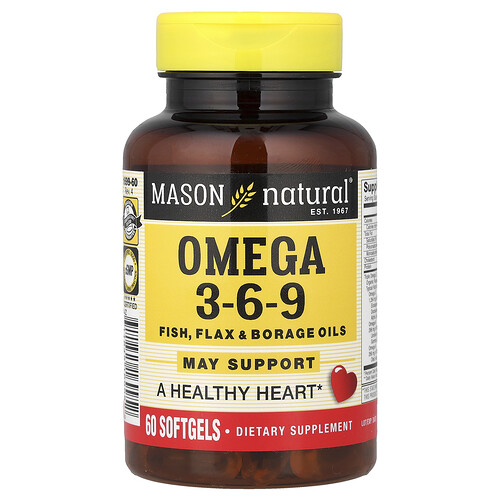
Sundown NaturalsOmega 3-6-9
732DCOmega 3 6 9
733Wonder LaboratoriesOmega 3 6 9
734MaritzMayer LaboratoriesEssential Fatty Acids 3600
735Nature's BountyFish, Flax, Borage 1200 mg
736Good 'N NaturalOmega 3-6-9 Proprietary Blend with Flax, Fish & Borage Oils
737Good 'N NaturalOmega 3-6-9
738Sundown NaturalsTriple Omega 3-6-9
739Sundown NaturalistOmega 3-6-9
7310Mason NaturalOmega-3-6-9
72